Leadguru and Leadverse both help you find people who are already looking for what you sell, but they read different parts of the internet. Leadverse monitors public social platforms — Reddit, X (Twitter), and LinkedIn — for high-intent conversations, scores them with AI, and helps you automate outreach. Leadguru monitors private communities you’ve joined — Slack workspaces, Discord servers, Telegram groups — where verified humans post under their real names. Both tools target B2B teams who want warm leads over cold outbound, but they sit on different sides of the public-vs-private conversation divide, and they target different ICPs at different price points.
Leadverse positions itself as an accessible entry point — paid plans start at $29/month, with a published 4.9 rating across 150 reviews. Leadguru is a multi-platform workspace with built-in CRM, identity enrichment, custom AI prompts, and historical archive scanning via Deep Research. The right choice depends on whether your buyers are posting publicly on Reddit and X, or asking behind closed doors in the Slack and Discord communities you already belong to.
At a Glance: Leadguru vs Leadverse
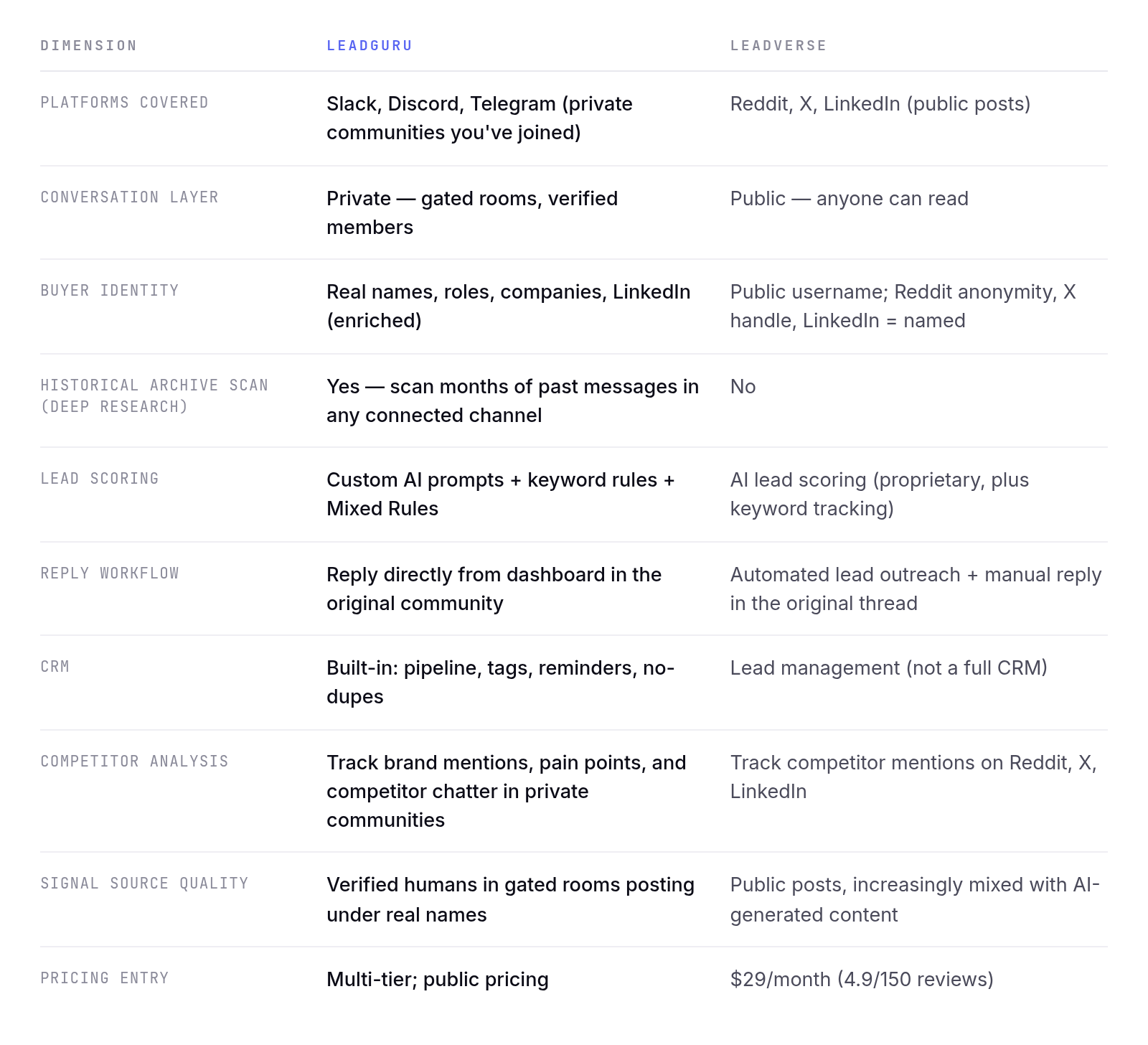
1. Public Posts vs Private Communities
The two products are solving the same underlying problem — “find people who are already asking for what you sell” — but they read entirely different conversation layers.
Leadverse watches the public social firehose. Anyone can search Reddit, browse X, scroll LinkedIn — Leadverse automates that browsing across three public platforms and uses AI to surface the conversations where someone is asking for what you sell. The advantage is breadth and accessibility: at $29/month, you can plug into the entire public conversation layer without joining any communities. The disadvantage is what the public conversation layer actually contains — anonymous Reddit users, AI-generated posts, marketing content disguised as intent, and a firehose of noise that has to be filtered.
Leadguru watches the private rooms you’ve already been invited into. You connect your Slack, Discord, and Telegram accounts, and the platform reads the conversations in communities you actually belong to. The advantage is data quality: every message comes from a verified human, posting under their real identity, in a gated room with active moderation. The disadvantage is breadth — you’re limited to communities you can join, and there’s a curation cost (you have to find the right rooms).
Why this matters: If your buyer is a CMO asking “what CRM do other 50-person SaaS companies use?” in a private RevOps Slack channel, Leadguru hears them and Leadverse doesn’t. If your buyer is a wedding planner asking “recommend a photographer in Nashville” on r/Nashville, Leadverse hears them and Leadguru doesn’t. Different surfaces, different buyers, different tools.
2. Signal Quality: Verified Humans vs AI-Generated Public Content
This is where Leadguru’s choice of conversation layer pays off structurally, and worth understanding in detail.
Public platforms are increasingly flooded with AI-generated content — blog posts, threads, replies, even entire accounts. By most estimates, more than half of new web content is now AI-generated or AI-assisted, and that proportion is highest on platforms with low posting friction (Reddit, X, Bluesky, Threads). For a tool monitoring Reddit and X, this creates a structural problem: a meaningful share of the “intent conversations” Leadverse surfaces may have been written by bots, by content marketers seeding keywords, or by LLMs trained to mimic buying-intent patterns. The platform’s AI scoring helps filter some of it out, but the underlying data is whatever is publicly posted.
Private communities you actually belong to — gated Slack workspaces, vetted Discord servers, curated Telegram groups — are dramatically harder to spam. Real-name verification, invite-only joins, and active moderation keep the conversation between verified humans posting about problems they actually have. Every message Leadguru surfaces was typed by a real member of a private community, under their real identity, with their name attached.
Why this matters for downstream analysis: If you’re using the insights for brand monitoring (“what are people saying about us?”), competitive intel (“how are customers describing our competitors?”), or market research (“what pain points keep coming up?”), the source data quality shapes the conclusions. Private-community data from Leadguru is a higher-trust sample per message. Public-platform data from Leadverse is a higher-volume sample at lower per-message trust. For high-stakes insights — exactly the kind an enterprise team or founder would want — Leadguru’s signal-to-noise ratio is structurally better.
3. Historical Archive Scanning
Another structural advantage of the private-community approach.
Leadguru’s Deep Research feature scans that history with an AI prompt or keyword rule, returning ranked intent matches in seconds. Workflow: join a community → run Deep Research → start with a populated pipeline of historical leads, then keep monitoring going forward.
Public platforms have aggressive rate limits and often prohibit historical scraping in their terms of service. Leadverse, like other Reddit/X/LinkedIn monitoring tools, works on the live stream: posts published after you started monitoring. Anything before that is invisible.
What this means in practice: If you start using Leadverse today, you build your pipeline from posts published today. If you join a new Slack community and connect it to Leadguru today, you can immediately scan its 6–12 months of history and surface leads that are still warm. For new communities and new accounts, that asymmetry compounds quickly.
4. Buyer Identity: Pseudonymous Reddit User vs Named Slack Member
The structural difference between public and private platforms hits identity hardest.
On Reddit (Leadverse’s largest source), the person asking “best CRM for solo agents” is u/throwaway_review42. You don’t know their company, their title, their budget, or whether they’re a real buyer or a student doing coursework. Identity resolution requires extra work and is often impossible.
On X, the same buyer might be a real-name account with a bio and a link — better, but inconsistent. Some accounts are pseudonymous, some are bots.
On LinkedIn (the third Leadverse platform), buyers are named, titled, and employed. Public posts link to public profiles. This is where Leadverse has the strongest identity signal.
On Slack , members usually have real names, photos, employer info, and link to public profiles. Leadguru automatically enriches those signals — when you see an intent message, you see the person’s role, company, and a clickable LinkedIn URL alongside. On Telegram and Discord, identity is partial but Leadguru surfaces what exists.
Practical impact: If your sales motion depends on personalization (named-account plays, ABM-style sequences, B2B contracts with multiple stakeholders), Leadguru’s identity enrichment makes every lead immediately actionable. Leadverse’s Reddit-sourced leads often need manual qualification before outreach.
5. Pricing and Positioning
Leadverse is positioned as an accessible entry point. Paid plans start at $29/month with a published 4.9 rating across 150 reviews, which signals strong product-market fit at the lower end of the market. For solo founders, freelancers, and small teams who want to dip into Reddit/X/LinkedIn monitoring without a sales conversation or a high monthly commitment, $29/month is a reasonable starting point.
Leadguru prices around team size and scale rather than offering a $29 entry tier. AI intent scoring, archive scanning, and CRM are bundled into plans designed for B2B teams who treat this as infrastructure rather than an experiment. There’s no free or $29 tier; the pricing reflects the value of a multi-platform workspace with verified-human data sources.
Honest caveat: If you only need Reddit monitoring, don’t have an audience in private communities, and want to test social-listening without committing to a higher-tier plan, $29/month at Leadverse is hard to argue with. The question is whether the public-firehose data quality is good enough to drive your pipeline at scale. For most B2B teams, the answer is “as a supplement, yes — as the primary lead source, no.”
6. Use Case Fit
Leadverse is positioned for solo founders, freelancers, and small teams who want accessible public-listening for B2B lead generation, competitive analysis, and brand monitoring across Reddit, X, and LinkedIn.
Leadguru is positioned for B2B SaaS, dev tools, agencies, and fintech teams whose buyers cluster in niche professional communities — RevOps Co-op, Mind the Product, Build in Public, regional founder Slacks, vertical-specific Discords, industry Telegram groups.
There’s some overlap, but the center of gravity is different. Leadverse’s ICP is the solo operator monitoring public conversations; Leadguru’s ICP is the sales team that has joined the private communities where their buyers already ask.
Who Leadguru Is Best For
- Your buyers are B2B decision-makers who congregate in private Slack, Discord, and Telegram communities.
- You want identity enrichment — real names, roles, companies, LinkedIn profiles — for personalized outreach.
- You want historical archive scanning (Deep Research) to backfill your pipeline from months of past conversations.
- You need verified-human data quality for brand monitoring, competitive intel, or market research.
- You prefer a unified workspace where you read conversations, draft replies, and manage pipeline in one place.
Who Leadverse Is Best For
- You’re a solo founder, freelancer, or small team just getting started with social listening.
- Your buyers post publicly on Reddit, X, or LinkedIn — and you’re not yet in private communities with them.
- You want an accessible $29/month entry point without a sales conversation.
- You primarily need lead monitoring + automated outreach for public posts, not deep CRM workflow.
- You want to test the social-listening category before committing to a higher-tier platform.
Migration: From Leadverse to Leadguru
If you’ve outgrown Leadverse — your ICP has shifted toward private communities, you need identity enrichment, or you’re tired of the public-firehose noise — adding Leadguru to your stack fills the private-conversation gap:
- Identify the private communities where your buyers actually ask — Slack workspaces, Discord servers, Telegram groups in your niche.
- Connect your existing Slack/Discord/Telegram accounts to Leadguru in under 5 minutes.
- Run Deep Research once on your top communities to find historical intent messages that would have been invisible to a public-only listening tool.
- Layer the two tools — Leadverse for public Reddit/X/LinkedIn posts, Leadguru for private conversations. They don’t overlap; they cover different surfaces of the same buyer activity.
Many teams run both during the transition: Leadverse catches the public posts, Leadguru catches the private threads, and the combined feed covers both sides of the conversation layer. As your private-community pipeline grows, Leadverse often shifts from “primary source” to “supplementary signal.”
Summary
- Leadguru is a private-community monitoring platform — Slack, Discord, Telegram — with built-in CRM, identity enrichment, custom AI prompts, and historical archive scanning via Deep Research. Data comes from verified humans posting under their real names in gated rooms.
- Leadverse is a public social listening tool — Reddit, X, LinkedIn — with AI lead scoring, keyword tracking, and automated outreach, starting at $29/month.
- Both tools surface warm leads from conversations, but they read opposite sides of the same wall. The right answer depends on whether your buyers ask publicly or privately, and whether you need high-trust verified-human data or accessible entry-level public-stream monitoring.
Want to see how Leadguru compares to other tools in adjacent categories? Read Leadguru vs GummySearch (also Reddit-focused, market research rather than sales) and Leadguru vs IntentHunter (broader public-platform coverage with seven surfaces). For more on Telegram-first competitors, see Leadguru vs LeadGenRunner and Leadguru vs CRMChat.