Leadguru and CRMChat both help B2B sales teams generate revenue from Telegram, but they solve opposite halves of the same problem. CRMChat is a Telegram-native cold outreach engine — multi-account, automated sequences, with a CRM bolted on for closing deals. Leadguru is an intent-monitoring platform — it surfaces people already asking for what you sell in Slack, Discord, and Telegram, then gives you a workspace to manage the warm outreach that follows. One tool creates demand from scratch via cold sequences; the other finds existing demand in conversations that are already happening.
CRMChat (formerly Hints) has 4 years in the Telegram CRM market and is trusted by Web3 companies like TON Foundation, Solana Superteam, and 300+ GTM agencies. Leadguru is a multi-platform community monitoring tool with built-in CRM, identity enrichment, and historical archive scanning via Deep Research. The right choice depends on whether your Telegram pipeline is built on cold outbound or warm inbound conversations.
At a Glance: Leadguru vs CRMChat
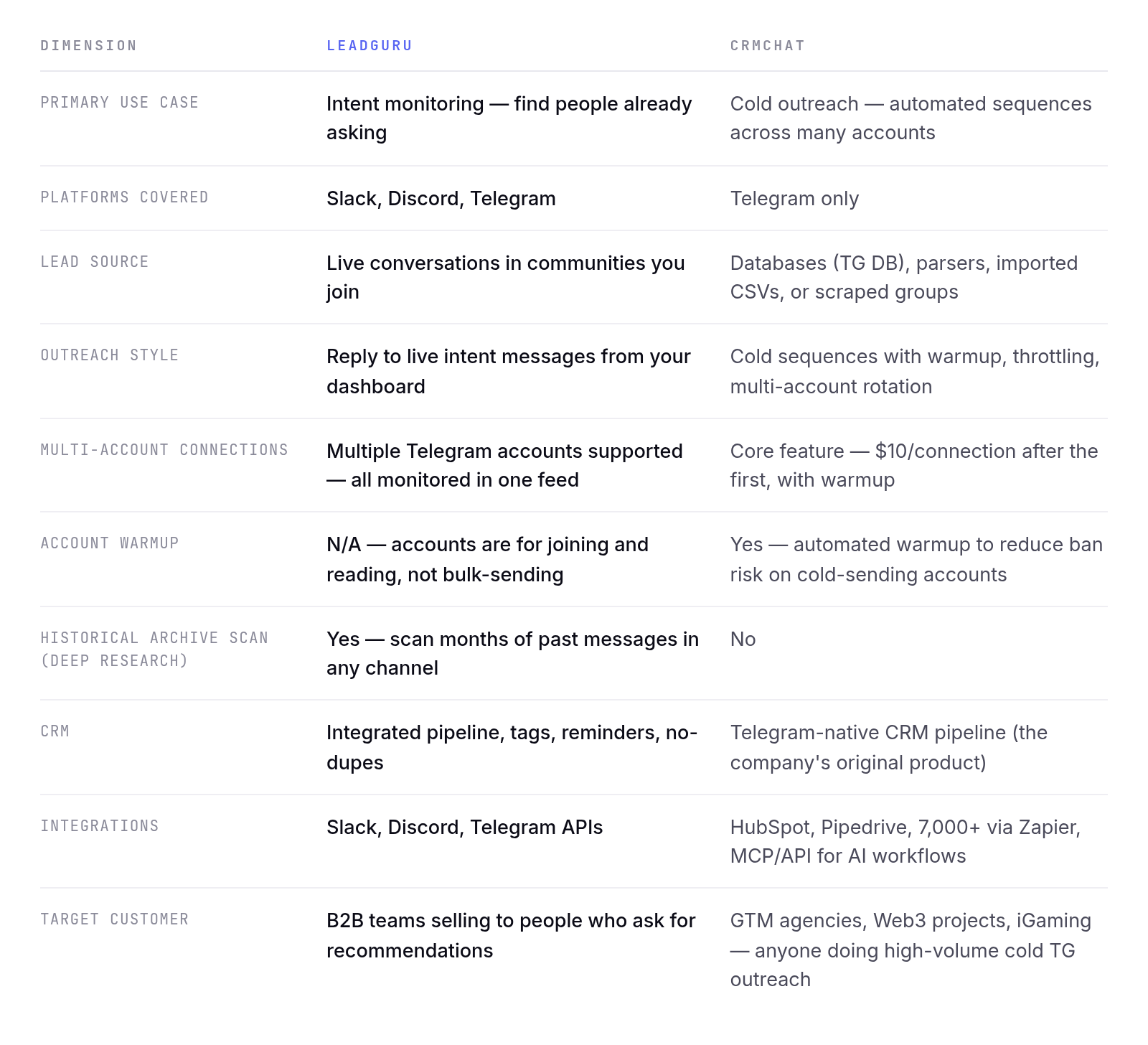
1. The Core Philosophy: Find Demand vs Create Demand
This is the single biggest difference, and it dictates everything else.
CRMChat is built for cold outbound. You connect Telegram accounts (the first one free, then $10 per additional connection per month), warm them up so they don’t get banned, build a prospect list from their 7,000+ Web3 TG database or your own import, and launch automated sequences. Each account is throttled — based on their published safety limits, around 10 cold and 50 warm messages per account per day. The whole product is engineered around the mechanics of sending many messages safely: warmup, rotation, throttling, sequencing, reporting.
Leadguru is built for warm inbound. You join the communities where your buyers hang out, set up intent filters (“anyone asking for a CRM,” “looking for a React dev”), and the platform shows you real-time messages where people already want what you sell. No sequences, no warmup, no multi-account rotation — because you don’t need them. You’re responding to existing intent, not manufacturing attention.
The trade-off: Cold outreach is scalable but expensive (you pay in account risk, deliverability, and conversion rates of 1–5%). Warm inbound has higher per-lead ROI but a finite ceiling — only so many people ask for what you sell on any given day. Most teams need a mix; the tools make different mixes easy.
2. Lead Source: Live Conversations vs Databases and Parsers
CRMChat treats the prospect list as a separate input. You can pull from their internal Web3 TG Database, run a Telegram Group Parser (Chrome extension + in-app tool), import a CSV, or scrape a public group. The value CRMChat adds is after you have the list: sequencing, warmup, CRM, analytics.
Leadguru treats the conversation itself as the lead source. You don’t need a list because the platform surfaces messages as they’re posted. The advantages: every lead has expressed clear intent (they typed the words “looking for X”), identity is enriched when possible (real name, role, company), and you skip the data-quality problem that comes with bought or scraped lists.
Where CRMChat wins: If you sell to a niche where buyers don’t openly post (enterprise, regulated industries, senior decision-makers), you have no choice but to build a list and reach out cold. CRMChat’s database + parser + outreach workflow is purpose-built for that.
Where Leadguru wins: If your buyers congregate in communities and do ask for recommendations — which is most B2B niches today — Leadguru’s approach skips the entire prospecting step and gets you straight to a context-rich first message.
3. Multi-Account Connections: Both Tools Support Them, Different Reasons
Both Leadguru and CRMChat support multiple Telegram account connections, but they serve different purposes in the workflow.
CRMChat treats multi-account as the core of cold outbound infrastructure. The Team plan is $34/seat/month with the first Telegram account included, then +$10 per additional connection per month. Each account goes through automated warmup to reduce ban risk before it starts blasting sequences, and the system rotates accounts to stay under Telegram’s safety thresholds (around 10 cold + 50 warm messages per account per day). The Agency tier is for “20+ members or 50+ outreach accounts” — they expect users to run hundreds of accounts. This is the workflow they sell to GTM agencies running Telegram outbound as a service.
Leadguru also supports multiple Telegram accounts. Each account joins its own set of communities, and all monitored conversations land in one unified feed alongside Slack and Discord. The reason is breadth of coverage: one person might not be in every relevant community, and clients often want their team members’ accounts connected so the platform sees conversations from multiple angles. There is no warmup step, no per-account send throttling, no rotation — because the platform reads and replies, it doesn’t bulk-send.
If your motion is “send 10,000 personalized cold DMs per month from 50 warmed accounts,” Leadguru is the wrong tool. If your motion is “monitor 200 communities across 3 accounts and reply to 50 warm intent messages per week,” CRMChat is overkill — but both tools accept the multi-account setup you’d want for their respective workflows.
4. CRM and Integrations
CRMChat was originally a Telegram CRM (formerly Hints), so the pipeline functionality is mature: deals, stages, tags, tasks within deals, morning digest emails, multi-device access (Telegram mini app + web). It can integrates directly with HubSpot and Pipedrive using API or webhook, plus 7,000+ tools via Zapier, and exposes an MCP/API for AI-agent workflows.
Leadguru has its own integrated CRM designed for the warm-outbound workflow: tag by status (“qualified,” “needs follow-up”), assign to a teammate, set reminders, prevent duplicate outreach, track outcomes. The integrations story is platform-first (Slack, Discord, Telegram APIs) rather than ecosystem-first.
Both tools have working CRMs. The difference is what gets logged — CRMChat logs outbound sequences and replies; Leadguru logs inbound conversations and follow-ups.
5. Deep Research: One Tool Has It, One Doesn’t
Leadguru’s Deep Research scans the full history of any connected channel with an AI prompt or keyword rule. For communities you’ve just joined or for long-running channels where you need to backfill your pipeline, this is the difference between a useful week and a wasted month.
CRMChat doesn’t have an equivalent feature because it doesn’t monitor conversations — it sends them. The closest workflow is running their Group Parser to scrape historical members, but that gives you a contact list, not context-rich intent messages.
When Deep Research matters most: joining a new Slack community, switching from another monitoring tool, or preparing a sales campaign for a niche where the historical volume of relevant posts dwarfs the new ones.
6. Pricing
CRMChat’s pricing (yearly billing, the default shown):
- Free: Forever-free tier. 1 Telegram account, 50 CRM leads, unlimited campaigns, basic CRM + chat. Good for testing the workflow.
- Personal: $20/month yearly. 1 Telegram account, unlimited CRM leads, Zapier + MCP/API.
- Team: $34/seat/month yearly. Unlimited TG accounts (1st free, +$10/connection after), team workspace, AI account warmup, advanced reporting.
- Agency: Custom. For 20+ members or 50+ outreach accounts.
Yearly billing saves 30%, quarterly 15%. The cost driver is connections: at scale, $10/connection/month adds up fast — 50 connections = $500/month on top of seats.
Leadguru prices around team size and scale rather than per-account-connection. AI intent scoring, archive scanning, and CRM are bundled. There’s no warmup surcharge because warmup isn’t a feature you’d need.
Honest caveat: CRMChat’s free tier is genuinely useful for solo operators who want to test Telegram outreach before committing. Leadguru doesn’t have a permanent free tier — the closest is a trial.
Who Leadguru Is Best For
- Your buyers congregate in Slack, Discord, or Telegram communities and openly ask for recommendations.
- You prefer warm outbound and inbound over cold outbound — high conversion, lower volume.
- You want historical archive scanning (Deep Research) to backfill your pipeline from past conversations.
- You want identity enrichment (real names, roles, companies) to personalize at scale.
- You run a sales team that needs shared CRM visibility, multiple Telegram accounts connected for broader community coverage, and warm intent from Slack/Discord/Telegram — but doesn’t need to blast cold DMs from warmed accounts.
Who CRMChat Is Best For
- You sell in Web3, iGaming, or another Telegram-first niche where buyers don’t openly post intent messages.
- You run a GTM agency that delivers Telegram outreach as a service to multiple clients.
- You need multi-account cold sequences with warmup, throttling, and rotation — the actual mechanics of safe Telegram outbound.
- You want direct integrations into HubSpot or Pipedrive rather than working inside the lead source’s dashboard.
- You operate at a scale (50+ outreach accounts) where the per-connection cost model makes sense for your unit economics.
Migration: From CRMChat to Leadguru
If you’re on CRMChat and your buyers have started posting intent messages in communities, switching means adding a warm-inbound channel rather than replacing cold outbound entirely:
- Connect Slack, Discord, and Telegram to Leadguru alongside your CRMChat Telegram accounts.
- Set intent filters that match your CRMChat prospect criteria — same ICP, same buying signals.
- Use Deep Research once on your top communities to find historical intent you missed.
- Import your existing CRM data (deals, tags) into Leadguru’s CRM as a starting pipeline. Both tools support CSV import.
Many teams end up using both — CRMChat for the cold outbound motion, Leadguru for the warm inbound layer. They’re complementary, not substitutes.
Summary
- Leadguru is a multi-platform intent-monitoring tool with built-in CRM, identity enrichment, and Deep Research for historical archive scanning. It finds leads who already want what you sell.
- CRMChat is a Telegram-native cold outreach engine with multi-account infrastructure, warmup, sequences, and a mature CRM. It creates conversations where none existed.
- Both tools help you close deals on Telegram, but they sit on opposite ends of the demand-generation spectrum. The right answer depends on whether your Telegram pipeline is built on cold outbound, warm inbound, or a mix of both — and both tools support multi-account Telegram connections to scale whichever motion you choose.
Want to see how Leadguru compares to other monitoring and scraping tools? Read Leadguru vs PhantomBuster and Leadguru vs GummySearch. For a deeper look at another Telegram-first competitor, see Leadguru vs LeadGenRunner. For an in-depth look at archive scanning, see how to use Deep Research to find high-intent leads.