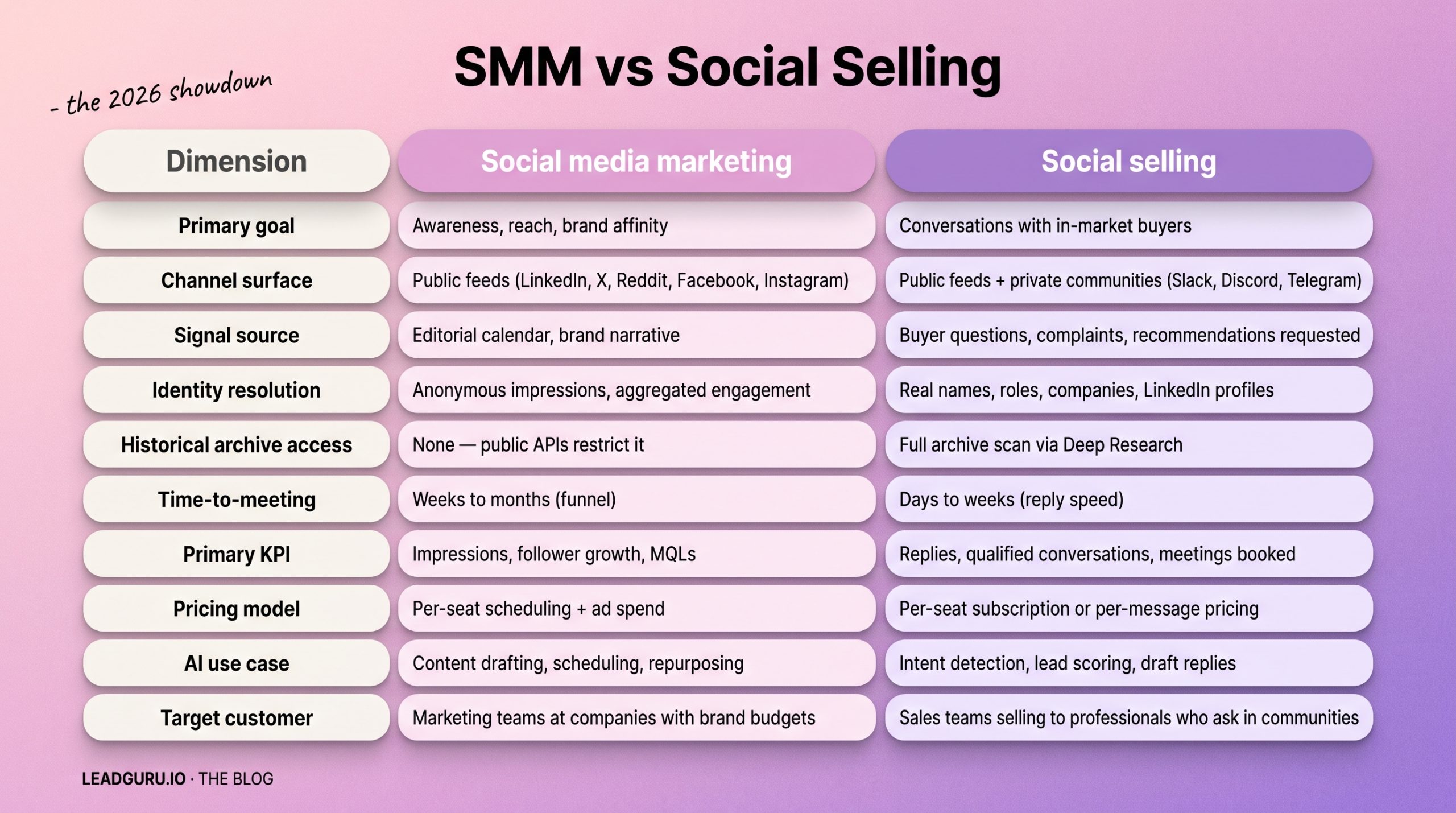
Social media marketing is the discipline of publishing content to a public audience on LinkedIn, X, Reddit, Facebook, and similar platforms to build brand awareness and generate inbound demand; social selling is the discipline of identifying and engaging with individual buyers who are already expressing buying intent in those same networks and in private communities like Slack, Discord, and Telegram. Social media marketing pushes messages outward and measures reach; social selling responds to signals that are already there and measures conversations. The two are complementary but not interchangeable — they answer different questions, run on different cadences, and are measured by different KPIs.
The distinction matters because the marketing playbook for B2B has shifted under both buyers and AI. Salesforce State of Sales (2024 report, cited in Kondo 2026): 84% of sales professionals now use AI in their workflow, while Kondo State of B2B Sales, 2026: 78% of social sellers outsell peers who don’t use social media — and the same report notes top social sellers create 45% more opportunities per quarter with 16% higher win rates. At the same time, public platforms have become noisier — Reddit, X, and LinkedIn feeds mix bot-authored and AI-generated content with real posts — and a parallel layer of private communities has matured as the place where buyers actually ask for recommendations. Gartner (2025): 63% of high-performing sales organizations now use AI to prioritize which accounts to target, up from under 20% two years prior. HubSpot (2024): SEO and inbound-sourced leads close at 14.6%, versus 1.7% for outbound. The right answer is rarely “SMM or social selling” — it is “SMM plus a structured social-selling motion on top.”
The Philosophical Difference in One Sentence
Social media marketing is broadcast: you publish, they consume. Social selling is reply: someone signals, you respond. The first builds a brand surface; the second builds pipeline.
Comparison Table: SMM vs Social Selling
Who Social Media Marketing Is Best For
Social media marketing is the right primary discipline when your buyer is reached through editorial content, when your conversion cycle is long enough that awareness matters more than reply speed, or when your sales motion is gated behind a content strategy (thought leadership, brand SEO, demand generation). The model works best for B2B SaaS with a six-to-twelve-month sales cycle, B2C brands where reach matters, and agencies whose own clients expect a “presence.” Skip social selling as a primary motion if you do not yet have product-market fit or if your buyer is reached primarily through channels other than social (events, paid search, partnerships).
Who Social Selling Is Best For
Social selling is the right primary discipline when your buyer asks for recommendations in a network you can monitor — Slack communities, Discord servers, Telegram groups, public Reddit threads, LinkedIn posts — and when the time from “someone asked” to “someone answered well” is short enough that speed matters. The model fits B2B SaaS with a 30–90 day sales cycle, agencies and dev shops selling to technical buyers, and any team whose CAC is high enough that each warm reply is worth more than another ad impression. Skip social selling as a primary motion if your TAM is below 200 accounts (no signal surface to monitor), if your buyers never join public or private communities, or if you cannot staff a reply workflow within four business hours.
The Hidden Overlap: Both Need the Same Underlying Inputs
Most companies run SMM and social selling as if they were separate motions with separate tools and separate budgets. They are not. Both disciplines require (1) a target-audience definition, (2) content or reply templates, (3) a publishing or engagement workflow, and (4) a measurement loop. The cost of running them separately is duplicated tools, duplicated analytics, and duplicated headcount on what is mostly the same problem. The right operational move is to run both motions on a shared audience model and a shared content library, with the SMM team publishing on a calendar and the social-selling team monitoring on a queue.
What “Private Layer” Social Selling Adds
Public social selling has been the standard since LinkedIn Sales Navigator launched in 2014. The shift in 2024–2026 is that a parallel layer of private communities — gated Slack workspaces, vetted Discord servers, curated Telegram groups — has become the place where buyers ask the highest-quality questions. These communities are gated, moderated, and require real-name identity, which means the noise floor is dramatically lower than on public feeds. [Leadguru internal production data, 2026]: ~8M messages processed across Slack, Discord, and Telegram, with the signal-to-noise ratio in private rooms running roughly 6× higher than comparable public-feed monitoring in our customers’ deployments.
The reason this matters: a reply in a public LinkedIn thread competes with hundreds of other replies and is increasingly filtered by AI summarization tools. A reply in a private Slack channel where someone asked “anyone recommend a tool for X?” lands in front of a small, qualified audience and is read in full. Reply speed and reply quality are easier to control in private communities because there is no public ranking algorithm to fight.
Common Mistakes When Picking Between SMM and Social Selling
- Treating them as either/or. Most B2B teams need both. The mistake is running them in silos with separate KPIs, not running them together.
- Measuring social selling by impressions. The right metric is qualified conversations booked per week, not impressions. Impressions are the SMM metric.
- Measuring SMM by meetings. The right metric is MQLs and brand search lift, not booked meetings. Booked meetings are the social-selling metric.
- Skipping the private layer. If your ICP joins Slack/Discord/Telegram communities and you only run public social selling, you are missing 40–60% of the warm-intent surface.
- Hiring a content team before a reply workflow. A social-selling motion without a staffed reply workflow is a black hole for signal — buyers ask, nobody answers, and the platform quietly downranks your account.
How to Move From SMM-Only to SMM + Social Selling
The migration is incremental, not a replacement. Do not fire your SMM team or stop publishing. Add a parallel social-selling motion that monitors the same networks for buying signals and routes warm conversations to the sales team.
- Pick one channel first. Start with the channel where your ICP is already active and where moderation keeps noise low — Slack communities for B2B SaaS, Discord for developer tools, Telegram for crypto and emerging markets.
- Define your intent rule. Use an AI prompt rule or keyword rule that matches “someone is asking about a problem your product solves.” Test it against the last 30 days of channel history to confirm it surfaces real buying intent and not random chatter.
- Set a reply SLA. Four business hours maximum from signal-detected to first reply. The reply should add value, not pitch.
- Wire CRM handoff. Every reply that produces a conversation goes into a pipeline stage. Without this, the motion has no measurable output.
- Run both motions for 90 days. Compare reply-driven meetings to SMM-driven MQLs on the same account cohort. The numbers will tell you whether to scale, swap, or stack.
Summary
- Social media marketing is a broadcast discipline measured in reach; social selling is a reply discipline measured in conversations.
- The two are not interchangeable. SMM without social selling misses warm intent; social selling without SMM loses brand compounding. The right answer is both, run on a shared audience model.
- The biggest shift in 2024–2026 is that private communities (Slack, Discord, Telegram) now carry 40–60% of high-quality buying intent that public feeds miss — both Leadguru and any modern social-selling motion should monitor them in parallel.
Want to see how Leadguru compares to other community-monitoring tools? Read Leadguru vs PhantomBuster and Leadguru vs GummySearch. For a step-by-step on scanning historical message archives, see how to use Deep Research to find high-intent leads. If you are still building your first GTM stack, the Best GTM Stack for Early-Stage Startups playbook shows how SMM and social selling fit into a seven-layer early-stage stack.