Leadguru and IntentHunter both surface warm leads from online conversations, but they listen on opposite sides of the same wall — and the data quality is fundamentally different. IntentHunter monitors public social platforms — Reddit, X, LinkedIn, Hacker News, Bluesky, Threads, and YouTube — for anyone, anywhere asking for what you sell. Leadguru monitors private communities you’ve joined — Slack workspaces, Discord servers, Telegram groups — where verified humans post under their real names. One tool reads public posts at internet scale but increasingly mixes in AI-generated noise; the other reads private conversations from real people, where deals actually close.
Both tools use AI to score each match for buying intent (IntentHunter uses a 0–100 score; Leadguru uses AI prompts + keyword rules) and draft a reply. The difference is the conversation layer: public posts anyone can see, or private communities only members can read. The right tool depends on whether your buyers ask in the open or in the rooms you’ve already been invited into.
At a Glance: Leadguru vs IntentHunter
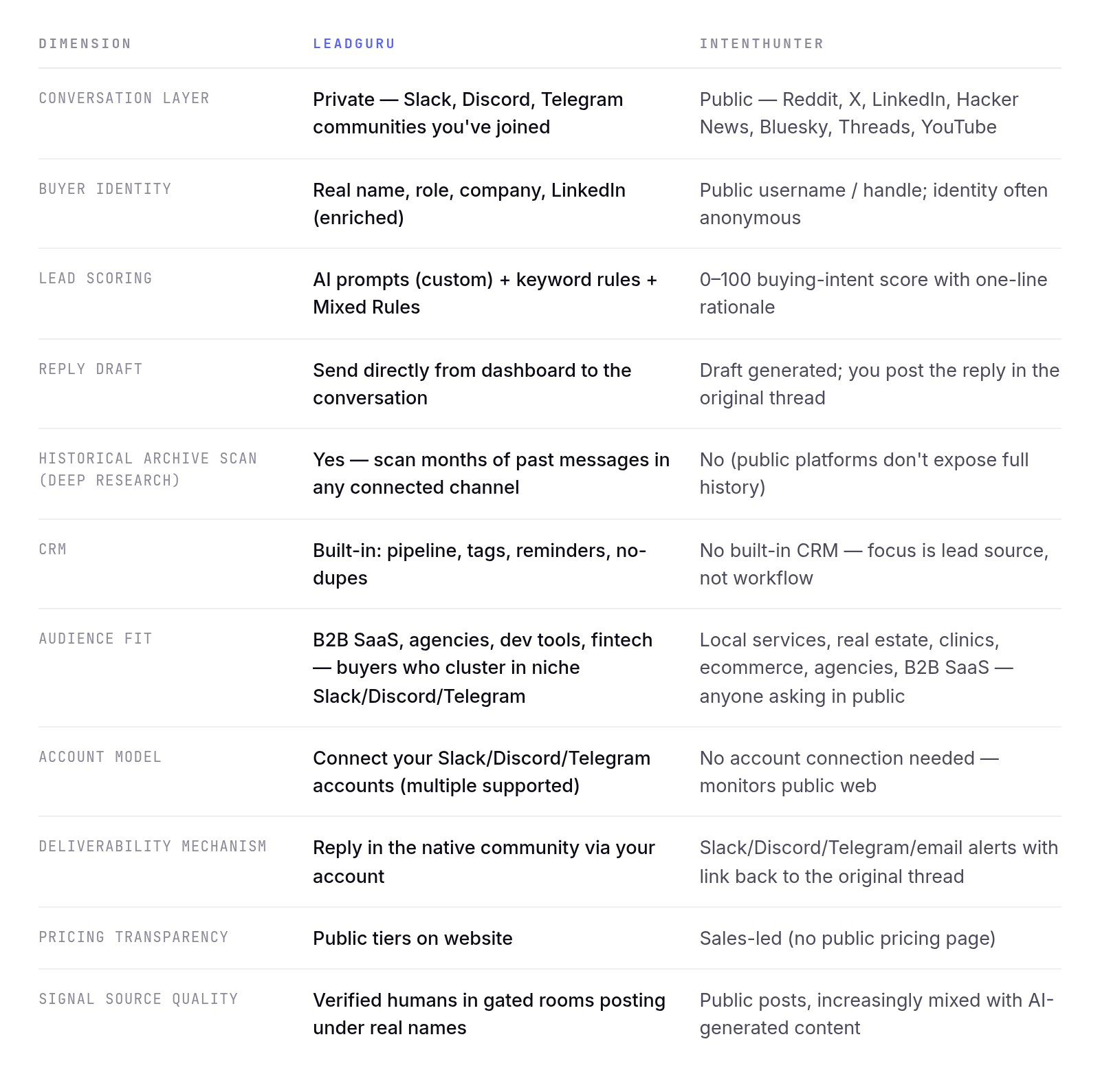
1. Public Posts vs Private Communities
This is the single biggest difference, and it’s worth sitting with for a minute.
IntentHunter reads the open internet. Anyone can search Reddit, browse X, scroll LinkedIn — IntentHunter automates that browsing across seven public platforms at once and uses AI to filter for buying-intent conversations. The advantage is reach: a SaaS founder on Hacker News asking “best email tool for a $30k/mo Shopify store” is a public signal that anyone with social listening tools can find. The disadvantage is that the most valuable conversations often don’t happen there — they happen in private Slack workspaces and Discord servers where competitors can’t lurk.
Leadguru reads the rooms you’ve already been invited into. You connect your Slack, Discord, and Telegram accounts, the platform watches the communities you’re a member of, and surfaces intent messages you would have seen if you’d read every message in every channel every day. The advantage is quality and exclusivity: the conversations are private, the buyers are typically named, and there’s far less noise (no meme threads, no hot takes, no competitor pile-ons). The disadvantage is that you’re limited to communities you can actually join.
When each layer matters: Buyers asking “best CRM for solo agents under $50/mo” on r/RealEstate are public; the same buyer asking the same question in a private RevOps Slack channel is private. Both conversations are real and worth acting on — but you need different tools to hear them.
2. Identity: Named Buyer vs Pseudonymous Post
The second-biggest difference, and the one most teams underestimate until they’re already sending outreach.
On Reddit, X, Bluesky, Threads, and (often) Hacker News, the person asking “recommend an analytics tool that isn’t as overwhelming as Mixpanel” is User_18472. You don’t know their company, their title, their budget, or whether they’re a real buyer or a student doing research. Identity resolution requires extra work — and on some platforms, the user has explicitly chosen to remain anonymous.
On LinkedIn (one of IntentHunter’s seven platforms), the same buyer is named, titled, and employed. IntentHunter links to the public post.
On Slack and Telegram communities (where Leadguru operates), members usually have real names, photos, employer info, and link to their public profiles. Leadguru automatically enriches those signals — when you see an intent message, you see the person’s role, company, and a clickable LinkedIn URL alongside the original message. On Discord, identity is partial (username + display name + whatever the user has linked to their profile), but Leadguru surfaces what exists.
Why it matters: Outreach to a named VP of Sales at a 50-person SaaS company converts differently than outreach to u/throwaway_review42. If your sales motion depends on personalization (named-account plays, ABM-style sequences), public social listening has a structural disadvantage on anonymous-heavy platforms.
3. Historical Archive Scanning: Public APIs Don’t Allow It
This is where Leadguru has an asymmetry that IntentHunter can’t match, and it’s worth understanding why.
When you join a Slack workspace, Discord server, or Telegram group, the platform’s API gives you access to the channel’s message history — typically months, sometimes years, depending on the community’s retention settings. Leadguru’s Deep Research feature scans that history with an AI prompt or keyword rule, returning ranked intent matches in seconds. The workflow: join a community → run Deep Research → start with a populated pipeline of historical leads, then keep monitoring going forward.
Public platforms like Reddit, X, LinkedIn, and YouTube have aggressive rate limits and often prohibit historical scraping in their terms of service. Even when API access exists, it’s expensive and capped. IntentHunter — like every other social listening tool — works on the live stream: posts published after you started monitoring. Anything before that is invisible to the tool.
What this means for new communities: If you join a Slack community today, Leadguru can immediately scan its history and surface intent from the past 6–12 months. If you start monitoring a subreddit today, IntentHunter can only show you posts from that day forward.
4. Scoring: Custom AI Prompts vs 0–100 Score
Both tools use AI to filter noise from signal, but they expose the model differently.
IntentHunter uses a fixed 0–100 buying-intent score plus a one-line rationale (“matches because: comparing tools, mentions budget”). The score is consistent across conversations, which is good for sorting and triage. The constraint is that you can’t customize the prompt — the model is what it is.
Leadguru lets you write your own AI prompt in natural language. “Find messages where someone is looking for a B2B SaaS tool that helps with outbound sales automation, exclude job postings and people offering services.” The AI evaluates each message against your prompt. You can run multiple prompts (one per ICP) and combine keyword pre-filters with AI scoring via Mixed Rules. The constraint is that custom prompts take more setup than a fixed score, but they let you encode ICP-specific nuance that a generic score would miss.
Which approach is better: Depends on whether your ICP is well-defined and consistent across conversations (IntentHunter’s fixed score works well) or whether you sell to multiple distinct verticals that each have their own buying signals (Leadguru’s custom prompts are more flexible).
5. Reply Workflow: Post in the Thread vs Reply from the Dashboard
IntentHunter drafts a reply and links you to the original thread. You click through, open Reddit/X/LinkedIn, log in, and post the reply yourself. The tool is a research assistant, not a send mechanism — which makes sense for public platforms, where auto-posting from a third-party tool would violate most platforms’ ToS.
Leadguru sends replies directly from your connected Slack, Discord, or Telegram account. You write (or accept an AI-suggested) message in the dashboard, and it lands in the original channel as you. The advantage is speed — you respond within minutes while the lead is still at their desk. The constraint is that the reply has to come from your account, which means you need to be a member of the community already.
Both approaches respect platform norms; they’re just different mechanisms for getting your reply in front of the lead.
6. Use Case Fit
IntentHunter positions itself for: Solo founders, agencies, ecommerce, local services (real estate, dental, law, fitness), B2B SaaS, fintech. Anywhere buyers ask for recommendations in public posts.
Leadguru positions itself for: B2B SaaS, dev tools, agencies, fintech — buyers who cluster in niche professional communities (RevOps Co-op, Mind the Product, Build in Public, regional founder Slacks, vertical-specific Discords, industry Telegram groups).
There’s overlap, but the center of gravity is different. If your buyers are consumers or local-business clients (someone moving to a new city looking for a dentist, a couple planning a wedding), they’re probably asking on Reddit or Facebook Groups — IntentHunter’s turf. If your buyers are B2B decision-makers (a RevOps director at a Series B SaaS evaluating CRMs, a CTO at an agency hiring contractors), they’re probably asking in private Slack/Discord communities — Leadguru’s turf.
Who Leadguru Is Best For
- Your buyers are B2B decision-makers who congregate in private Slack, Discord, and Telegram communities.
- You want identity enrichment — real names, roles, companies, LinkedIn profiles — for personalized outreach.
- You want historical archive scanning (Deep Research) to backfill your pipeline from months of past conversations.
- You prefer a unified workspace where you read conversations, draft replies, and manage pipeline in one place.
- You sell to multiple verticals and need custom AI prompts for each ICP.
Who IntentHunter Is Best For
- Your buyers ask for recommendations in public — Reddit, X, Hacker News, LinkedIn, YouTube.
- You sell to consumers or local businesses (dental, legal, real estate, fitness, ecommerce) who post publicly.
- You want a fixed 0–100 buying-intent score for quick triage across many conversations.
- You don’t need a built-in CRM — you already use HubSpot, Pipedrive, or another system.
- You operate at a breadth where monitoring seven public platforms surfaces enough leads without joining private communities.
7. Signal Quality: Verified People vs AI-Generated Noise
Public platforms are increasingly flooded with AI-generated content — blog posts, threads, replies, even entire accounts. By some estimates, more than half of new web content is now AI-generated or AI-assisted, and that proportion is highest on platforms with low posting friction (Reddit, X, Threads, Bluesky). For social listening, this creates a structural problem: a meaningful share of the “intent conversations” a tool surfaces may have been written by bots, by content marketers seeding keywords, or by LLMs trained to mimic buying-intent patterns.
Private communities you actually belong to — gated Slack workspaces, vetted Discord servers, curated Telegram groups — are dramatically harder to spam. There is typically a real-name verification step, an invite-only join flow, and active moderation. The people posting in those rooms are real humans, posting under their real identities, about problems they actually have. The data you extract from those conversations is closer to ground truth than a Reddit thread that may have been written to manipulate a tool’s classifier.
Leadguru reads only the rooms you’ve joined. Every message surfaced by the platform was typed by a real member of a private community you belong to. The insights — buying intent, brand mentions, competitor complaints, pain points — come from a verified human being, not from a generated post.
IntentHunter reads the public firehose. That gives it reach but also exposes it to AI-generated noise. The platform’s scoring helps filter some of it out, but the underlying data is whatever is publicly posted — and a growing share of public posts is machine-written.
Why this matters for downstream analysis: If you’re building a brand-monitoring dashboard, a competitive-intel report, or a market-research summary, the source data quality shapes the conclusions. Private-community data from Leadguru is a higher-trust sample per message; public-platform data from IntentHunter is a higher-volume sample at lower per-message trust. For high-stakes insights (what are real customers actually saying?), Leadguru’s signal-to-noise ratio is structurally better.
Migration: From IntentHunter to Leadguru
If your ICP has shifted toward private communities — or you’re finding that public posts are increasingly anonymous and hard to convert — adding Leadguru to your stack fills the private-conversation gap:
- Identify the private communities where your buyers actually ask — Slack workspaces, Discord servers, Telegram groups in your niche.
- Connect your existing Slack/Discord/Telegram accounts to Leadguru in under 5 minutes.
- Run Deep Research once on your top communities to find historical intent messages that would have been invisible to a public-only listening tool.
- Layer the two tools — IntentHunter for public posts, Leadguru for private conversations. They don’t overlap; they cover different surfaces of the same buyer activity.
Many teams end up running both: IntentHunter catches the public Reddit posts, Leadguru catches the private Slack threads, and the combined feed covers both sides of the conversation layer.
Summary
- Leadguru is a private-community monitoring platform — Slack, Discord, Telegram — with built-in CRM, identity enrichment, custom AI prompts, and historical archive scanning via Deep Research. Data comes from verified humans posting under their real names in gated rooms.
- IntentHunter is a public social listening tool — Reddit, X, LinkedIn, Hacker News, Bluesky, Threads, YouTube — with a fixed 0–100 buying-intent score and one-line rationales for triage. Data comes from public posts, including a growing share of AI-generated content.
- Both tools surface warm leads from conversations, but they read opposite sides of the same wall — and the source data quality is structurally different. The right answer depends on whether your buyers ask in the open or in private rooms, and whether you need high-trust verified-human data or high-volume public-stream data.
Want to see how Leadguru compares to other tools in adjacent categories? Read Leadguru vs GummySearch (also Reddit-focused, narrower ICP) and Leadguru vs PhantomBuster (scraping vs intent). For more on Telegram-first competitors, see Leadguru vs LeadGenRunner and Leadguru vs CRMChat.