Leadguru and LeadGenRunner are both Telegram-first community lead generation tools that monitor Telegram groups, classify incoming messages by intent, and surface warm leads ready for outreach. The core difference is scope: LeadGenRunner is a Telegram-only monitor with credit-based AI usage. Leadguru is a multi-platform workspace that covers Telegram, Slack, Discord, and the channels you’ve already joined — with built-in CRM, contact export, and historical archive scanning (Deep Research) on top of the same intent-based lead feed.
Both tools exist because the most valuable B2B conversations have moved out of public social feeds and into private communities. According to Gartner, 80% of B2B sales interactions now occur in digital channels — and a growing share of those happen in chat apps where people ask for recommendations in real time. The right tool depends on whether Telegram is your only acquisition channel, or one of several.
At a Glance: Leadguru vs LeadGenRunner
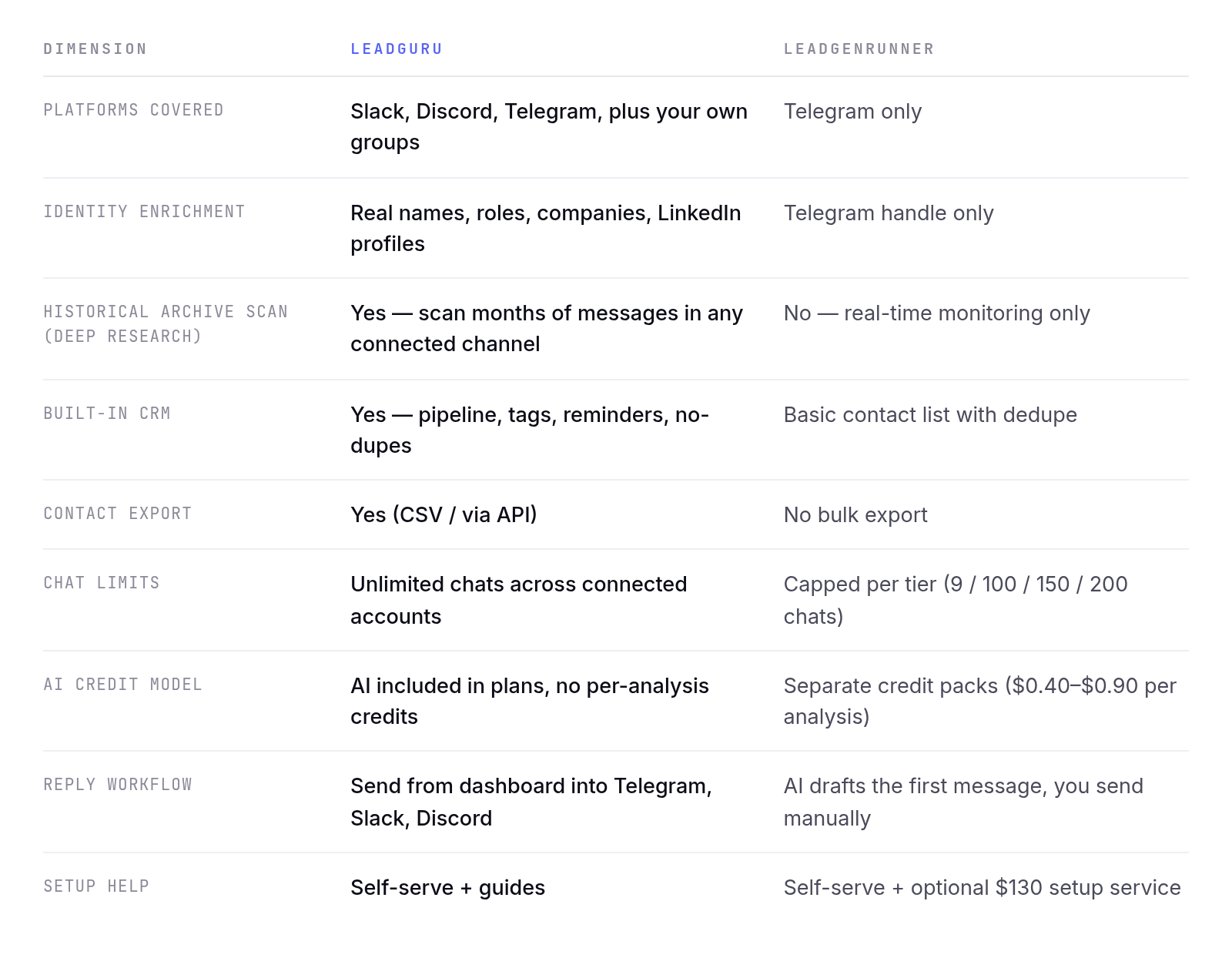
1. Platform Coverage: Telegram-Only vs Multi-Channel
The most fundamental difference between the two tools.
LeadGenRunner is purpose-built for Telegram. It connects one Telegram account via the official Bot API, monitors the chats you select, and that’s the entire surface area. For a freelancer or small agency that lives entirely inside Telegram groups, this focus is a feature, not a limitation — there’s nothing else to learn.
Leadguru treats Telegram as one of several channels. The same dashboard monitors your Telegram groups, Slack workspaces, and Discord servers. If your buyers split time between a Slack community like Pavilion, a Discord like Build in Public, and a regional Telegram channel, you see all of those conversations in one feed, with the same intent classification applied across platforms.
The trade-off: LeadGenRunner goes deeper on Telegram-specific UX (comment-thread scraping, similar-channel AI search, lead-temperature tags in Russian). Leadguru goes wider — fewer Telegram-only niceties, but you don’t lose leads the moment your buyer posts in a Slack workspace instead of a Telegram group.
2. Identity: Telegram Handle vs Real Person
In a Slack community, when someone writes “Looking for a CRM for our 12-person sales team,” you can see their name, their title, their company, and click straight to their LinkedIn. In Telegram, the same request often comes from @alex_1987 with a profile photo you can’t trace back.
LeadGenRunner keeps the conversation in Telegram-native form: you see the username, the message, and a temperature tag (hot / warm / cold). Resolving who that person actually is — finding their company, their role, whether they have budget — is your job.
Leadguru does identity resolution across platforms. For Slack and Discord members (and for Telegram accounts that have been linked to public profiles), the dashboard shows the real name, current role, company, and a clickable LinkedIn URL. When you reach out, you can personalize against actual context — not a handle.
The trade-off: For Telegram-only workflows where many users intentionally stay pseudonymous, Leadguru’s enrichment returns partial information more often. LeadGenRunner doesn’t pretend to know more than Telegram exposes.
3. Deep Research: Real-Time vs Real-Time + Archives
This is where the two tools diverge most sharply in day-to-day usefulness.
LeadGenRunner is real-time only. The instant a message matches your keywords, you get a notification. Messages from yesterday, last week, or last month — already gone, even if they were perfect leads. If you joined a group today, you’ve already missed whatever was posted before you connected.
Leadguru includes Deep Research — the ability to scan the full message history of any connected channel with an AI prompt or keyword rule. Within minutes you can pull every “looking for [X]” message from the last three months, score each one for intent, and start reaching out. Combined with real-time monitoring, you get complete coverage of past and present conversations.
Why it matters: The average active Telegram group generates 500–2,000 messages per day. Real-time monitoring from “now” ignores that entire backlog. For B2B teams who join a channel and need leads this week, archive scanning is the difference between waiting a month for the real-time feed to accumulate versus being productive on day one.
4. CRM and Workflow: Standalone Tool vs Workspace
LeadGenRunner treats itself as a lead source — it hands you the message and a suggested first reply. Where the lead goes after that (your CRM, your spreadsheet, your head) is up to you. Dedupe exists within LeadGenRunner so you don’t reply to the same person twice, but there’s no pipeline, no tags, no follow-up reminders.
Leadguru is built as a workspace. Every lead is a row in an integrated CRM — you can tag it (e.g., “qualified,” “needs follow-up”), set a reminder for 3 days from now, assign it to a teammate, and track outcomes. For sales teams that need shared visibility on what’s being worked, this is the difference between a tool and a workflow.
Both tools support contact export — Leadguru explicitly (CSV / Pipedrive); LeadGenRunner via the dashboard’s per-contact view. If your downstream is HubSpot, Pipedrive, or a sheet, you can move the data either way, but Leadguru’s export is bulk-first.
5. Pricing and Limits: Credit vs Subscription
LeadGenRunner’s pricing is two-layered:
- Subscription tiers cap the number of chats per account (9 / 100 / 150 / 200) and the number of leads per month (500 / 5,000 / 15,000 / ∞).
- AI analysis credits are billed separately — 10 for $9, 50 for $29, 200 for $79. Each “deep analysis” of a channel before you commit to monitoring it costs one credit.
- There’s also an optional $130 “full setup” service where their team configures your keywords and picks channels for you.
Leadguru prices around scale and team size, not per-analysis credits. AI intent scoring, archive scanning, and CRM are part of the platform — there’s no separate meter ticking every time you evaluate a channel.
Honest caveat: LeadGenRunner’s lower entry price ($9/mo Starter) is genuinely cheaper than most Leadguru plans for solo operators monitoring a handful of chats. The credit model penalizes heavy AI usage; the chat cap penalizes broad monitoring. For a Telegram-only workflow with predictable volume, that math can work in their favor.
6. Speed and Reliability
LeadGenRunner advertises ~30-second response time on matched messages, which matches what Telegram’s Bot API allows for incoming updates. Leadguru targets similar speed on its real-time feed, with the added benefit that the unified inbox covers all platforms without you watching four apps.
Both tools use official platform APIs (Telegram Bot API for both; Slack and Discord official APIs for Leadguru), so account-ban risk is comparable and low. LeadGenRunner emphasizes EU server hosting and data deletion on request; Leadguru’s privacy posture is similar but worth verifying on its privacy page if your buyers are in regulated industries.
Who Leadguru Is Best For
- You sell B2B and your buyers split time between Slack, Discord, and Telegram — not Telegram alone.
- You need to identify who’s actually behind a message (real name, role, company, LinkedIn) for personalized outreach.
- You want historical archive scanning to find leads in months of past conversations, not just real-time signals.
- You need a built-in CRM with pipeline tracking, tags, and reminders — not just a feed of messages.
- You want contact export to plug into your existing CRM or sales tools.
Who LeadGenRunner Is Best For
- You operate almost exclusively in Telegram and don’t need Slack or Discord coverage.
- You want Russian-language UX and Telegram-native ergonomics (comment-thread scraping, similar-channel AI search).
- Your volume is predictable and modest — under 5,000 saves/month — and the per-tier chat caps are not a constraint.
- You’d rather pay $130 once for their team to configure keywords and channels than set it up yourself.
- You’re okay with the Telegram handle as your only identity signal — your outreach doesn’t depend on LinkedIn enrichment.
Migration: From LeadGenRunner to Leadguru
If you’re on LeadGenRunner and hitting one of its limits — chat caps, lead caps, or the lack of Slack/Discord — switching is straightforward:
- Connect your existing Telegram account to Leadguru in under 5 minutes using the official Telegram login flow.
- Import your monitored chats — select the same groups you had on LeadGenRunner, plus any Slack workspaces and Discord servers you want to add.
- Reuse your keyword rules as a starting point. Leadguru’s Mixed Rules (keyword filter → AI intent scoring) is a drop-in upgrade over pure keyword matching.
- Run Deep Research once on your highest-value channels to surface leads you missed during real-time-only weeks on LeadGenRunner.
Existing contacts can be exported from LeadGenRunner’s dashboard and imported into Leadguru’s CRM as a starting pipeline. There is no formal migration tool, but the data is portable.
Summary
- Leadguru is a multi-platform community lead generation workspace with built-in CRM, identity enrichment, historical archive scanning, and contact export.
- LeadGenRunner is a focused Telegram monitor with credit-based AI analysis, ideal for solo operators with Telegram-only workflows and predictable volume.
- Both tools solve the same core problem — surfacing warm leads from community conversations — but at different scopes. The right choice depends on whether Telegram is your whole channel or one of several.
Want to see how Leadguru compares to other automation tools? Read Leadguru vs PhantomBuster and Leadguru vs GummySearch. For an in-depth look at archive scanning, see how to use Deep Research to find high-intent leads.