Lead generation is the process of attracting and converting people who might buy your product or service into someone who has expressed interest and can be entered into your sales pipeline. A lead is any identified person or company that matches your ideal customer profile and has shown a signal of intent — whether that signal is filling out a form, replying to an email, or posting in a Slack community asking for exactly what you sell.
Every B2B team runs lead generation, but the cost, speed, and conversion rate vary by an order of magnitude depending on the channel and the type of lead you’re working. According to a 2024 HubSpot State of Marketing report, 61% of marketers say generating high-quality leads is their top challenge. The teams that solve it reliably aren’t spending more — they’re working the channels where buyers already talk about their problems: private Slack workspaces, Discord servers, and Telegram groups.
What Is a Lead?
A lead is any person or organization that has been identified as a potential customer and has done something to indicate interest. The “something” varies by channel:
- Filled out a contact form on your website.
- Replied to a cold email.
- Liked or commented on one of your LinkedIn posts.
- Asked a question in a Slack community you’re part of — “anyone recommend a CRM for a 12-person sales team?”
- Downloaded a whitepaper or attended a webinar.
- Came through a referral from an existing customer.
Leads move through a pipeline of stages. The exact vocabulary differs by team, but the core progression is:
- Subscriber / raw lead — has shown a baseline signal but no intent to buy.
- Marketing-qualified lead (MQL) — matches your ICP and has engaged with marketing content.
- Sales-qualified lead (SQL) — has been qualified by sales as a real opportunity.
- Opportunity — active deal in negotiation.
- Customer — closed-won.
The earlier in this pipeline a lead is, the cheaper they are to acquire but the lower the conversion. The further along, the more expensive but the higher the close rate. The goal of every lead generation strategy is to push more leads further along the pipeline with less effort.
Cold vs Warm Leads: Why the Type Matters More Than the Channel
The most important distinction in lead generation isn’t between email and LinkedIn, or between ads and SEO. It’s between cold leads and warm leads.
Cold Leads
A cold lead is someone who has not yet expressed any interest in your product or category. They fit your ICP on paper — same industry, same role, same company size — but they don’t know you exist, and they haven’t publicly said they’re looking for what you sell. To convert a cold lead, you have to interrupt their day, earn their attention, and convince them they have a problem worth solving in the first place.
Cold outreach works at scale, but conversion rates are typically 1–5%. You pay for that scale in time (researching prospects, writing messages), deliverability (spam folders, account bans), and reputation (annoying people who weren’t asking). For some markets — enterprise sales, regulated industries, niche B2B where buyers don’t post publicly — cold is the only option. For most B2B niches, it’s not the smartest one.
Warm Leads
A warm lead is someone who has already expressed buying intent — explicitly or implicitly. They might have asked “anyone recommend a CRM for a SaaS company?” in a Slack workspace. They might have written “looking to switch from Mixpanel, what are the alternatives?” on Reddit. They might have mentioned a problem they’re solving in a Discord server. The signal is in the conversation; your job is to find it and reply.
Warm outreach converts 3–5x higher than cold outreach because you’re responding to an existing request, not creating one from scratch. The lead has already articulated the problem. They don’t need to be educated — they need to be served. According to Demand Gen Report, 70% of B2B buyers prefer peer-to-peer community recommendations over vendor-led content, which means a warm lead surfaced from a community is often more receptive than one sourced from a paid channel.
The catch: warm leads don’t appear in your CRM as neatly as form fills do. They’re scattered across thousands of conversations in Slack, Discord, and Telegram groups. Finding them manually is impossible at scale — you’d have to read every message in every channel every day. That’s the gap Leadguru fills.
The Main Lead Generation Channels
There are seven channel categories most B2B teams work. Each has different cost, speed, and conversion profile.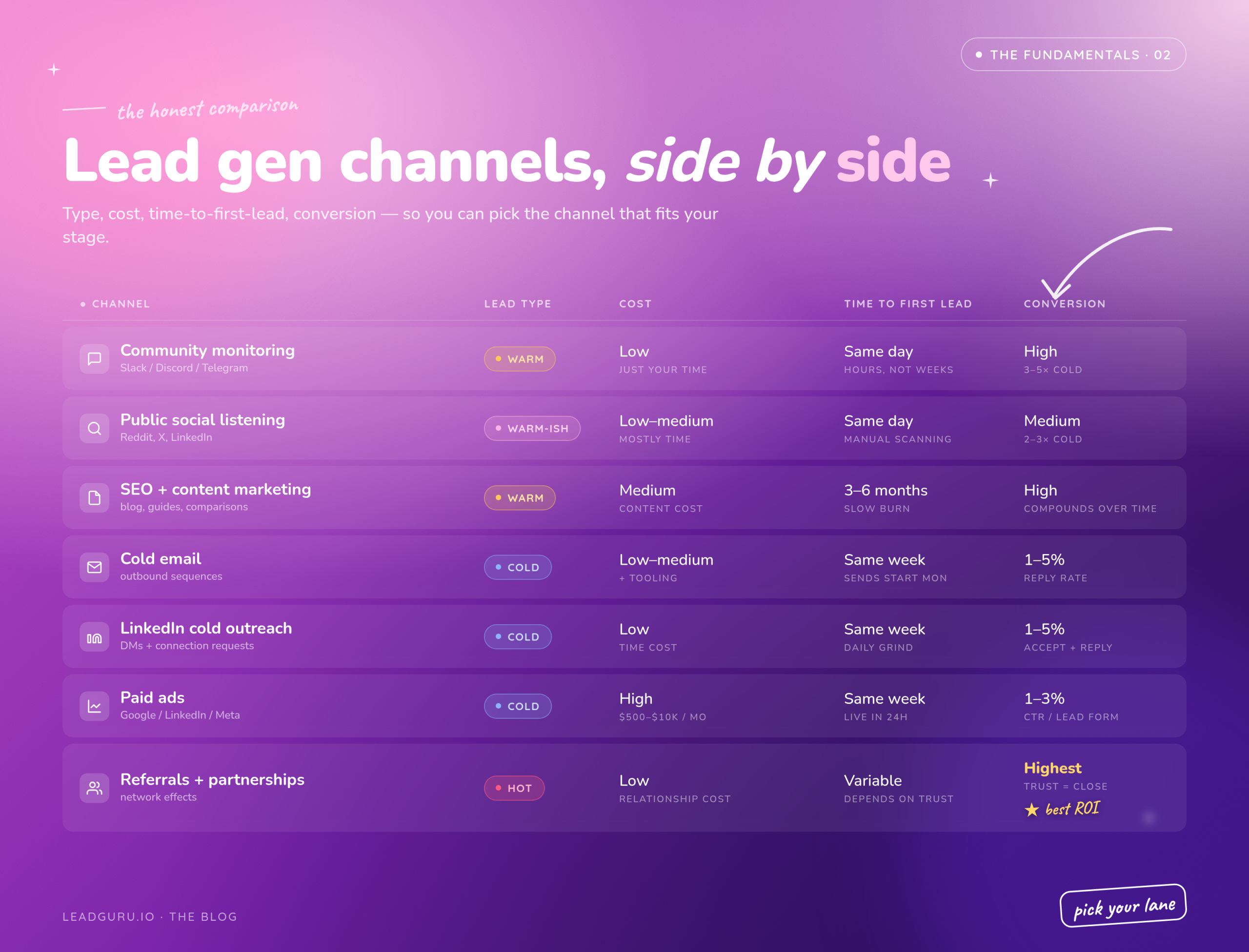
1. Community Monitoring (Slack, Discord, Telegram)
The shortest path between “your ideal customer exists” and “your ideal customer has asked for what you sell.”
Private communities are where B2B buyers go to ask for recommendations, compare tools, and describe their problems in detail — because the conversation is gated and members trust the room. A RevOps director asking “we’re evaluating CRMs for our 80-person SaaS, what have you used?” in a private Slack workspace is a high-intent lead by any definition: they have a budget, a timeline, and an active evaluation.
How it works: join the communities where your buyers congregate, monitor conversations for buying intent, reply when intent surfaces. Leadguru automates the monitoring part — you join the room, set keyword or AI rules, and the platform surfaces relevant messages in a unified feed.
Cost profile: low. No ad spend, no list-purchase, no per-message fees. You pay for the tool (and many platforms include unlimited community joins), and you invest your own time in writing good replies.
Best for: B2B SaaS, dev tools, agencies, fintech — anywhere buyers cluster in professional communities.
2. Public Social Listening (Reddit, X, LinkedIn)
The same intent-monitoring concept, applied to public platforms. Tools like IntentHunter, GummySearch, and Leadverse scan Reddit, X, LinkedIn, Hacker News, and others for recommendation requests and buying signals.
The trade-off versus community monitoring: public platforms give you breadth (anywhere can read the post), but the conversations are often anonymous, the per-message signal is mixed with AI-generated noise, and the historical archive is not accessible. Public social listening is a useful complement to community monitoring, but rarely a replacement.
Best for: consumer products, local services, and as a secondary signal for B2B teams already doing community monitoring.
3. SEO + Content Marketing
Publish content that ranks for the searches your buyers run — “best CRM for SaaS,” “how to choose a payment processor,” “Slack community alternatives.” When someone Googles a relevant query, they find your article, click through, and ideally convert on a lead capture form.
SEO works at scale (one article can produce leads for years) and converts warm (the visitor is actively searching). The downside is time: a new domain typically takes 3–6 months to start ranking for non-branded queries, and 6–12 months to hit a steady cadence.
Best for: companies with the budget to invest in content production and the patience to wait for compounding returns. Leadguru’s blog is a long-term SEO play alongside the short-term lead generation tool.
4. Cold Email
The classic outbound channel. Build a list of prospects matching your ICP, write a personalized email, send at scale, follow up.
Cold email works because it’s measurable and controllable — you can A/B test subject lines, send volumes, and follow-up cadences. Conversion is low (1–5%) but predictable. The cost is mostly time (writing copy, building lists) plus tools (Instantly, Smartlead, Lemlist, etc.).
Best for: enterprise sales, regulated industries, niche B2B where buyers don’t congregate publicly. Most teams should run cold email alongside community monitoring, not instead of it.
5. LinkedIn Cold Outreach
The same as cold email, but on LinkedIn — usually via connection requests + InMails or DMs. Higher trust than cold email (you can see the prospect’s full profile), but lower volume (LinkedIn throttles aggressive activity).
Works well for higher-ticket B2B where the relationship-building aspect matters. Conversion rates are similar to cold email (1–5%), but the average deal size tends to be higher.
6. Paid Ads (Google, LinkedIn, Meta)
Bid on keywords or audience attributes, show ads to people who match, capture leads via landing pages. The fastest channel for generating raw volume, but the most expensive.
Google Ads CPCs for B2B SaaS keywords typically run $5–$50. LinkedIn Ads run $8–$15 per click. To produce 100 leads per month from paid ads at a 2% landing-page conversion rate, you’re paying for 5,000 clicks — somewhere between $40,000 and $750,000 per month depending on the channel and keyword. That’s the structural reason most small and mid-sized teams can’t compete on paid acquisition.
Best for: companies with budget and a clear LTV math that justifies the spend. Less viable for early-stage or low-margin products.
7. Referrals + Partnerships
The highest-converting channel by far — referrals close 3–5x faster than leads from other sources because they arrive with built-in trust. The challenge is supply: you can only generate as many referrals as your existing customer base produces.
Best combined with other channels: every customer you close via community monitoring becomes a potential source of referrals down the line.
Why Warm Outreach Wins on Cost, Speed, and Conversion
If you sort the channels above by total cost to acquire a closed customer, the picture is consistent across industries: warm channels are cheaper per customer than cold channels. That’s not a marketing claim — it’s structural arithmetic.
Cold channels (paid ads, cold email, cold LinkedIn) pay for attention. You’re renting a stranger’s time, hoping some fraction will convert. The closer the lead is to your ICP and the more directly they’ve expressed intent, the more efficient the spend. Warm outreach flips the equation: the lead has already raised their hand. You just respond.
The math for a typical B2B SaaS team: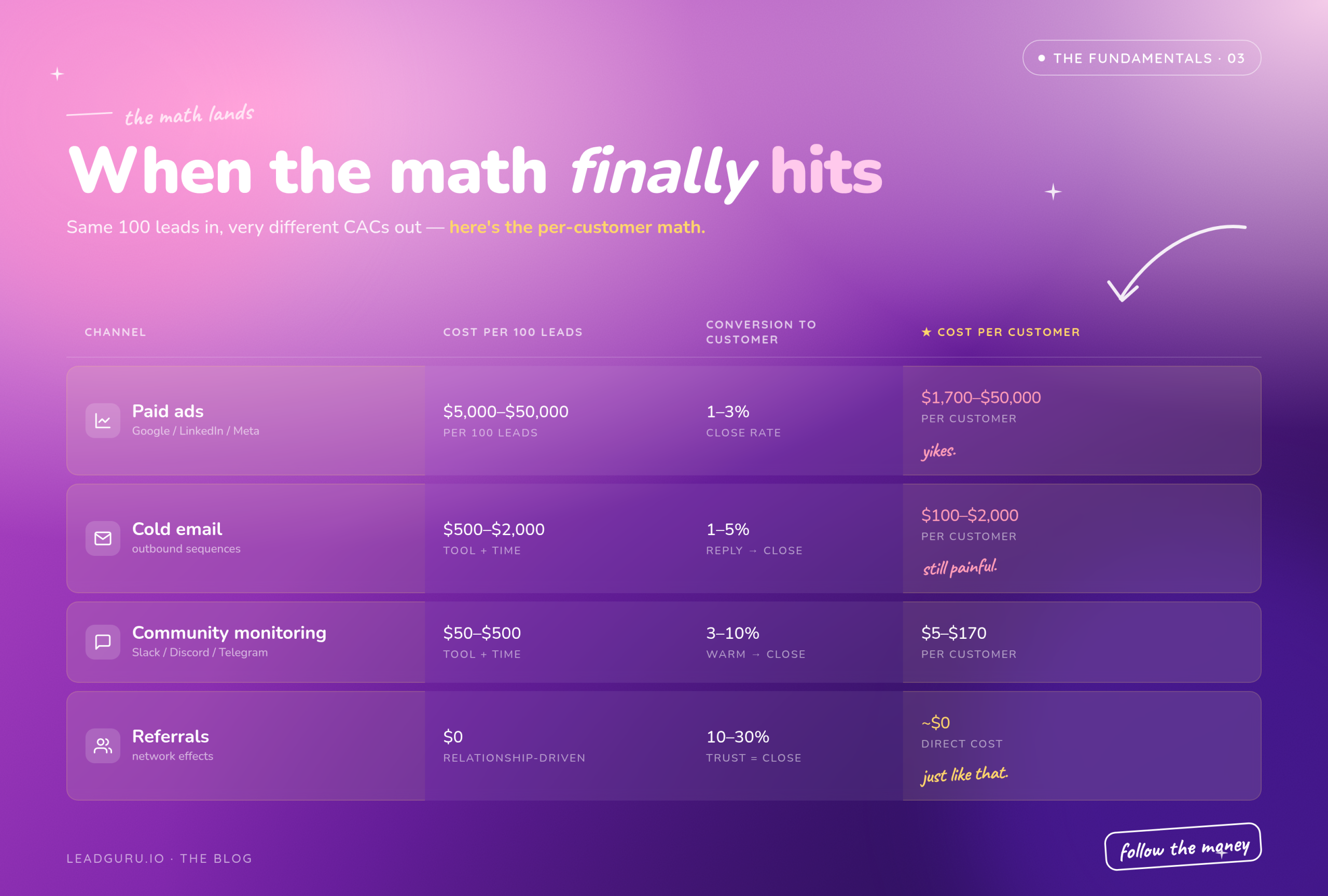
Note: these are illustrative ranges, not promises. Your numbers will vary by ICP, message quality, and competitive density. But the ordering holds across most B2B niches.
On speed: paid ads produce leads within hours of going live. Cold email produces replies within days. Community monitoring produces leads within hours of joining a relevant community and setting up monitoring — and Deep Research produces historical leads within minutes, even on day one. For new teams, that asymmetry is decisive.
On effort: cold channels require you to build lists, write cold copy, manage deliverability, follow up. Community monitoring requires you to join communities, set intent rules, and write contextual replies. The latter is less repetitive and produces warmer conversations — which is why most teams prefer it once they’ve tried both.
What Leadguru Does, in Plain Language
Leadguru is a community monitoring platform built for the warm-outreach model. You connect your Slack, Discord, and Telegram accounts, set up rules for what “intent” looks like (keywords, AI prompts, or both), and the platform surfaces buying-intent messages from private communities you’ve joined. When intent shows up, you see the original message, the author’s name and LinkedIn profile when available, and you can reply directly from the dashboard.
The two features that make it different from a “social listening tool”:
- Multi-platform coverage. One unified feed across Slack, Discord, and Telegram. No switching between apps, no missed conversations because they happened in a different tool.
- Deep Research. Instead of only catching new messages from the moment you start watching, you can scan months of historical conversations in any connected channel with an AI prompt. On day one of joining a new community, you can have a populated pipeline of leads from the past 6–12 months.
For teams that have decided warm outreach is the model they want to scale, Leadguru is the layer that makes it operational — instead of one person reading every Slack channel by hand, the platform watches everything and surfaces what’s relevant.
How to Start: A 15-Minute Setup
The fastest way to test warm outreach in your business is the Leadguru quick-start playbook. Connect one Slack, Discord, or Telegram account, generate a keyword list with help from an AI assistant, and run Deep Research on the communities you’ve joined. Most teams see their first leads within an hour.
Read the full Quick-Start Playbook for step-by-step instructions, or compare Leadguru to other monitoring tools in Leadguru vs IntentHunter and Leadguru vs Leadverse.